
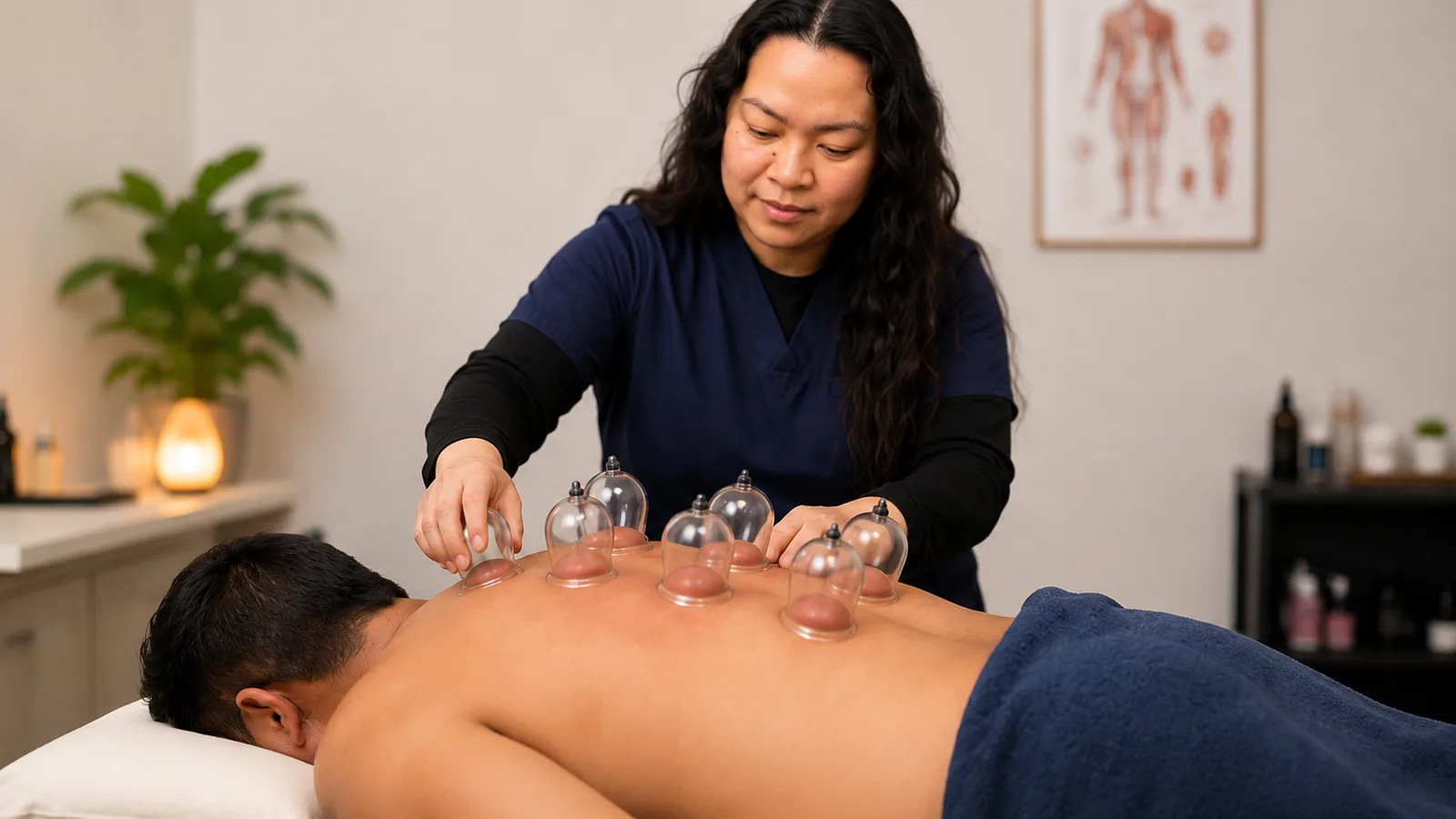
You've seen the circles — on an Olympic swimmer's shoulders, on someone at the gym, maybe on a friend who came back from a massage looking like they'd been attacked by an octopus. They're the main reason people hesitate to try cupping, and they're widely misunderstood.
Here's what those marks actually are, why they're not bruises, and what to expect if you book it.
Cupping works in the opposite direction to massage
Every other treatment we do presses into tissue. Cupping lifts it. A cup is placed on the skin and suction draws the tissue upward, decompressing the layers underneath instead of compressing them. That's the entire point — it reaches tight, overworked muscle from a direction hands can't.
At A-Game Care, cupping is provided by Registered Massage Therapists, either on its own or built into a massage session.
So what are the marks?
A bruise comes from impact — tissue damage from a blow. Cupping marks come from suction drawing blood flow toward the surface in an area where circulation has been poor. That's why they're circular, uniform, and — this is the telling part — they don't hurt. Press a bruise and you'll know about it. Press a cupping mark and you'll feel nothing much at all.
The colour varies, usually from light pink to a deeper purple, and it typically fades over several days to a week. Here's the useful part most people don't know: darker marks tend to appear where tissue was tightest. They're informative rather than alarming, and they're often lighter the next time you come in.
Does it hurt?
Most people describe a pulling or stretching sensation rather than pain — strange the first time, but not unpleasant. Suction is adjusted to your comfort throughout, and your therapist checks in. If it's too much, say so and it comes down.
What if you don't want marks
Fair enough — and there are options.
- Timing. If you have a wedding, a beach holiday or a photo shoot coming up, book cupping two weeks before rather than two days.
- Placement. Tell your therapist to keep the work below the collar line and nothing will show in normal clothing.
- Shorter duration and lighter suction. Both reduce how much marking occurs.
- Facial cupping leaves no marks at all — the suction is much lighter and the cups are small.
Who tends to benefit
- Tight backs, shoulders, hips and legs that haven't responded to pressure alone
- Athletes and physically active people in heavy training blocks
- People doing repetitive work — trades, farming, desk work
- Anyone whose therapist has found tissue that just won't release under hands
Who should check first
Cupping isn't right for everyone. Your therapist reviews your health history before starting and will tell you honestly if it isn't a fit — that includes anyone on blood thinners, with skin conditions in the treatment area, with certain circulatory conditions, or who is pregnant. If you're unsure, ask when you book.
Booking cupping in Olds
Myofascial cupping runs 45 minutes at $75 or an hour at $100, offered by Frances and Tracy. It combines well with deep tissue massage in the same session, and with Graston Technique where tissue is genuinely stubborn.
We direct bill most major insurers. Book online or call (587) 581-7176.