
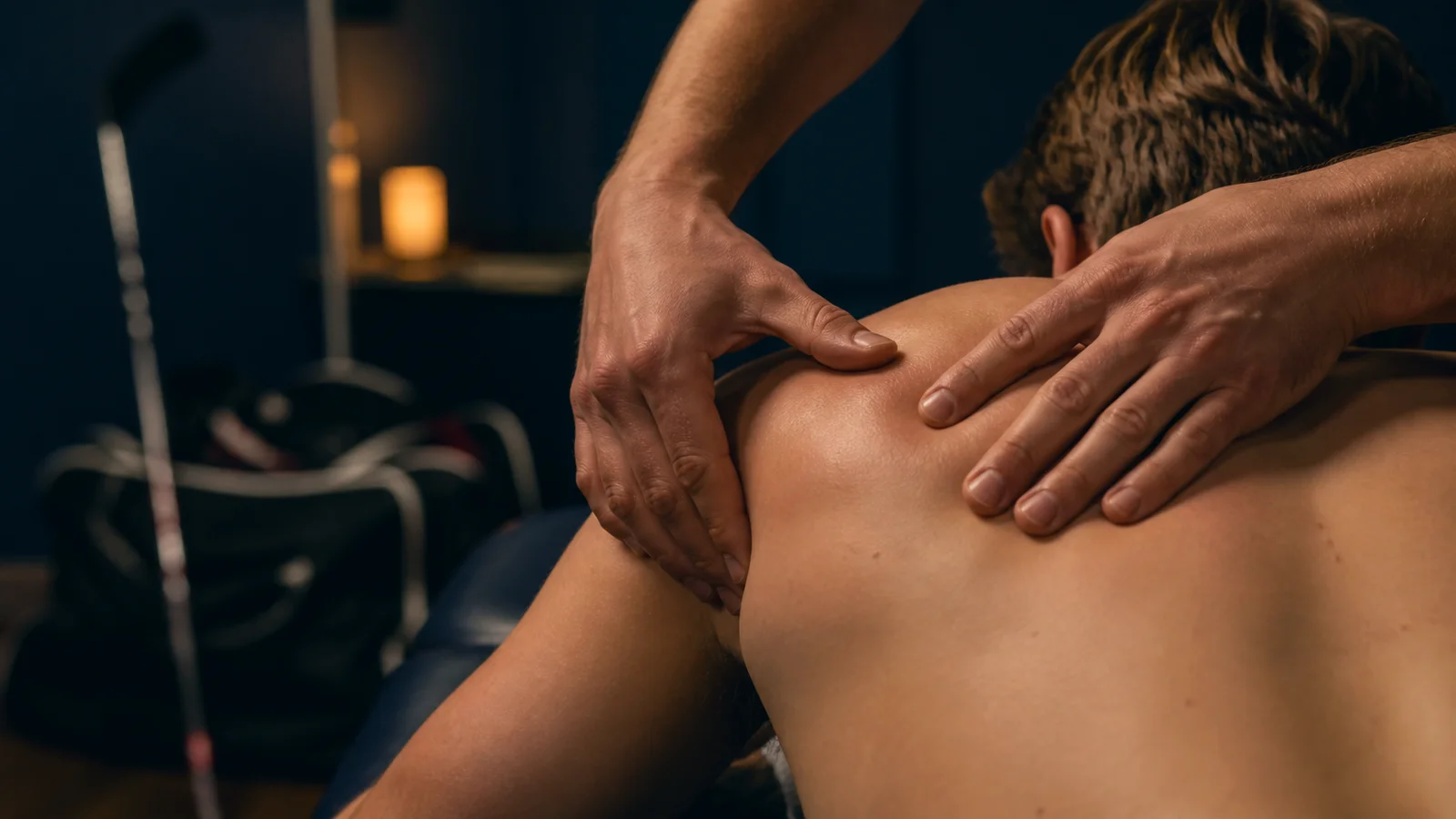
Hockey season starts and everything changes at once. Five-thirty ice times, tournaments two towns over, a bag that weighs half what your kid does, and a teenager who says they're fine because they always say they're fine.
Most of the soreness that comes with a season is normal. Some of it isn't. Here's how to tell the difference, and where recovery actually fits for a body that's still growing.
Why young athletes get sore differently than adults do
A teenager in the middle of a growth spurt is dealing with something adults aren't: bones lengthening faster than the muscles and tendons attached to them can adapt. That mismatch pulls things tight — particularly through the hips, hamstrings, quads and lower back, which is exactly where hockey loads the body anyway.
Add the sport's specifics on top. Skating is asymmetrical and hip-dominant. Shooting loads one side of the trunk over and over. Goalies live in positions no human body was designed to hold. And most kids play one sport year-round now instead of three seasonally, so the same tissues take the same load without a break.
Normal soreness vs. the kind worth paying attention to
Normal: general achiness for a day or two after a hard game or the first week back on the ice. It's diffuse — "my legs are tired" — it eases with movement, and it's gone within about 72 hours.
Worth attention:
- Pain in one specific spot they can point to with one finger.
- Soreness that's still there a week later, or that's getting worse rather than better.
- Pain that shows up during play rather than after it.
- Limping, favouring a side, or a change in how they skate.
- Pain that wakes them up at night.
Any of those, and the first call is your physician or a physiotherapist — not a massage therapist. Massage supports a body that's working hard. It doesn't diagnose, and it isn't the right first step for an injury that needs assessment.
Where massage therapy actually fits
For a healthy player getting through a long season, treatment does a few useful things: it addresses the tightness that builds through hips and legs before it starts changing how they move, it gives you a professional set of hands noticing asymmetries you can't see from the stands, and — not a small thing — it gives a teenager an hour where someone is paying attention to how their body feels.
Timing that works well through a season:
- Pre-season — one session as things ramp up, to start from a clean slate.
- In-season maintenance — every three or four weeks for most players; more often through tournament stretches.
- Post-tournament — within a day or two of a heavy weekend, when everything has been asked at once.
What a session looks like for a minor
We treat clients from age 3 to 17, and the structure is straightforward. A parent or guardian gives written consent before the first treatment and stays onsite for every appointment; for children under 12, a parent is in the treatment room. Sessions run from 15 minutes up to a full hour — for a younger athlete, shorter is usually better, and there's no benefit to booking longer than they'll actually tolerate.
Pressure is adapted for a growing body. A teenager is not a small adult, and treatment that's appropriate for a 40-year-old farmer isn't appropriate for a 14-year-old defenceman.
Three things that help more than most parents expect
- Carry the bag properly. A hockey bag on one shoulder, twice a day, five days a week, is a real asymmetrical load on a growing spine. Backpack-style or wheels.
- Sleep is the actual recovery tool. Everything else is support. Teenagers in heavy training need more than they think, and more than they're getting.
- Take the off weeks. A body that never has a lighter week never fully adapts. Scheduled rest isn't lost fitness.
Booking
Our minors massage is built for exactly this, and sports recovery massage suits older teens carrying a serious load. Sessions start at $40, we direct bill most major insurers, and you can book online or call (587) 581-7176.
We're on 50 Avenue in Olds, an easy drive from Didsbury, Carstairs, Bowden, Sundre, Innisfail and Three Hills — which covers most of the rinks your season is going to take you to anyway.