
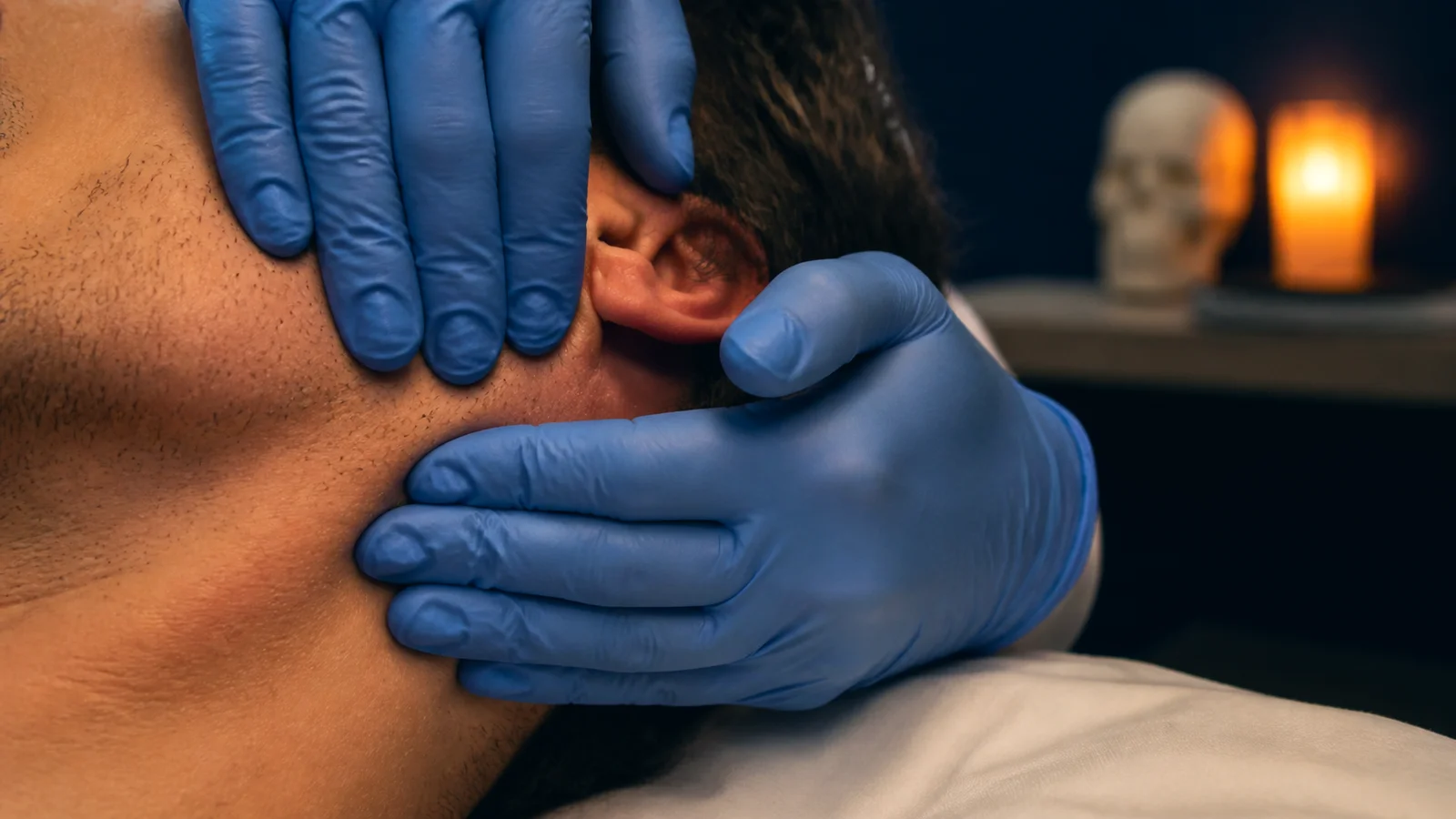
If your jaw aches by the end of the day, if you catch yourself clenching at the wheel, or if you wake up with a tight face and a headache that started somewhere near your ears — the muscles causing it may be somewhere no massage has ever reached.
Buccal massage is an intra-oral technique: the therapist works the muscles of your jaw from inside your mouth, wearing gloves. It sounds unusual the first time you hear it. It is also, for a lot of people, the first thing that actually touches the problem.
Why the jaw is hard to treat from the outside
The main muscles that clench your jaw sit deeper than they feel. The masseter — the one you can feel bulge when you bite down — has layers that wrap up under the cheekbone. The pterygoids sit further in still, behind the jaw joint, and they're a common source of the tension people describe as "in my ear" or "behind my eye."
You can press on the outside of the face all day and only reach the surface of that. Buccal work approaches the same muscles from inside the cheek, where the therapist can actually get a hand on them and work them the way any other tight muscle would be worked.
Who tends to benefit
- People who clench or grind. If your dentist has mentioned wear on your teeth, or you've been fitted for a night guard, the muscles doing that clenching have been working overtime for years.
- TMJ discomfort. Jaw pain, clicking, or a jaw that feels stiff and guarded when you open wide.
- Tension headaches that trace back to the temples and jaw rather than the neck.
- People under sustained stress. The jaw is one of the first places the body holds it, and one of the last places anyone thinks to treat.
What a session actually involves
Your therapist starts with your history — what you're feeling, when it's worst, whether you've seen a dentist about it. Then, wearing gloves throughout, she works the jaw muscles from inside the mouth using slow, sustained pressure, alongside hands-on work to the surrounding face, jaw and neck.
It is a strange sensation the first time. It should never be a painful one. You set the pace, you can pause at any point, and a good therapist checks in constantly rather than pushing through. Most people find the tender spots surprisingly specific — the "oh, that's where it's been" moment is common.
Afterwards your jaw may feel loose in a way it hasn't in a while, and it's normal for the muscles to feel worked the next day, the same as after any deep tissue treatment.
Buccal massage isn't a cosmetic treatment here
You may have seen buccal massage marketed as a facial or a sculpting treatment. That's a real use of the technique, but it isn't ours. At A-Game Care we offer it for what it does therapeutically: releasing jaw muscles that have been clenched for months or years. If you're looking for a facial, we're not the clinic. If your jaw hurts, we might be exactly the right one.
What it doesn't replace
If you have significant TMJ dysfunction, ongoing dental pain, or clicking with locking, see your dentist or physician. Buccal massage addresses the muscular side of the problem and works well alongside dental care — but it isn't a substitute for a proper assessment of the joint itself.
Where to find it
Buccal massage is offered at A-Game Care in Olds by Tracy, who is certified in the technique. It's one of the few places you'll find it between Calgary and Red Deer — and for people across Mountain View County who've been living with a jaw that never quite lets go, it's worth the short drive. If the tension runs into your neck and shoulders too, a deep tissue session in the same visit is a common pairing.